A market that must convert, and cannot pay for it.
European public and non-residential buildings face increasing pressure to renovate and replace fossil heating systems. Many institutions can fund an ongoing heating bill but cannot easily finance the full replacement infrastructure upfront.
A structural capital gap
GI addresses that gap by financing and owning the heating asset while the client continues to pay for heat as a service.
Pressure to modernize. A defined renovation timetable.
Renovation requirements and carbon pricing address different parts of the transition. Neither prescribes GI technology or pellet heating.
Heating fuels
EU carbon pricing expands to heating fuels.
16%
EU rules require renovation of the worst-performing 16% of non-residential buildings by 2030.
26%
EU rules extend the renovation requirement to 26% by 2033.
02 / Market size
From European demand to a focused addressable market.
Four distinct planning references. Market size describes the opportunity; it does not describe current GI revenue or market penetration.
TAM / European demandAnnual EU heating spend
€80B
2026 biomass segmentBiomass heating segment
€5–7B
SAM / Addressable marketDACH, Balkans and Eastern Europe
€1.5–2B
SOM / Target, not achievedLonger-term planned share≈6,500 contracts · €75M+ annual revenue
5% target
03 / Industrial geography
Bosnia is the start, not the market.
Bosnia and Herzegovina combines access to the wood and biomass industry with proximity to Central and Southeast Europe. A materially lower regional production cost base supports GI’s planned industrial approach close to European heating demand.
The strategy is cost-efficient production geography and regional market access. GI’s own pellet-production facility remains a Stage 1 objective; it does not exist yet.
04 / Planned market access
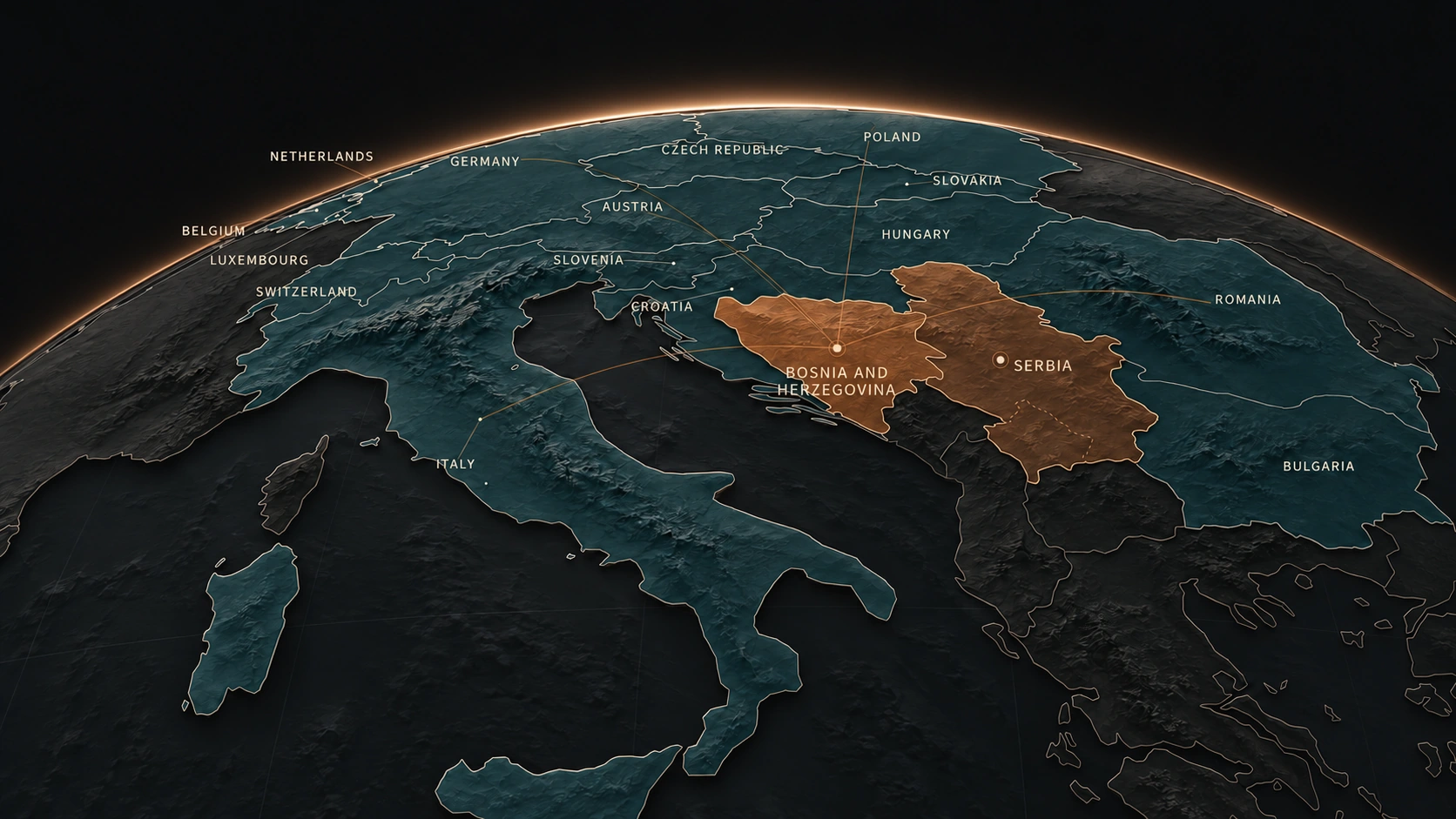
Two regional hubs. A phased European reach.
Bosnia and Herzegovina is the Phase 1 hub. Serbia is the planned Stage 2 hub. The 15 selected European countries form the Stage 3 target set.
Illustrative phased expansion. Not an operating or contracted logistics network.
Stage 3 / 15 planned target markets
Italy
Switzerland
Austria
Romania
Slovenia
Bulgaria
Hungary
Slovakia
Czech Republic
Poland
Germany
Luxembourg
Belgium
Netherlands
Croatia
05 / Phased production strategy
Two hubs, different roles.
Phase 1 / Planned first production base
Bosnia and Herzegovina
Establish first production capacity, support the first operating portfolio and prove vertically integrated fuel supply.
The facility does not yet exist. This is the first-stage industrial objective.
Stage 2 / Planned second production hub
Serbia
The planned second production facility is in Sremska Mitrovica, adding capacity and regional redundancy with improved access to eastern and central target markets.
The Sremska Mitrovica facility is planned, not operating today.
Resilience through regional capacity.
Two regional bases are intended to reduce dependence on one production site, support shorter regional access and bring additional capacity closer to target demand.
Selected markets / Deliberate expansion
DACH, the Balkans and Eastern Europe.
A staged addressable-market strategy, not a simultaneous launch across Europe.
01Prove the model in the initial region.
02Establish production capacity.
03Build operational references.
04Expand through selected European markets.
06 / Customer need
The customer already pays for heat.
The problem is financing the replacement asset.
GI targets buildings with existing, unavoidable heating expenditure and a need for modernization. The opportunity is broader than growth in biomass demand alone.
The model aims to turn existing heating spend into a long-term infrastructure service relationship: GI finances and owns the asset, while the institution pays for heat.